

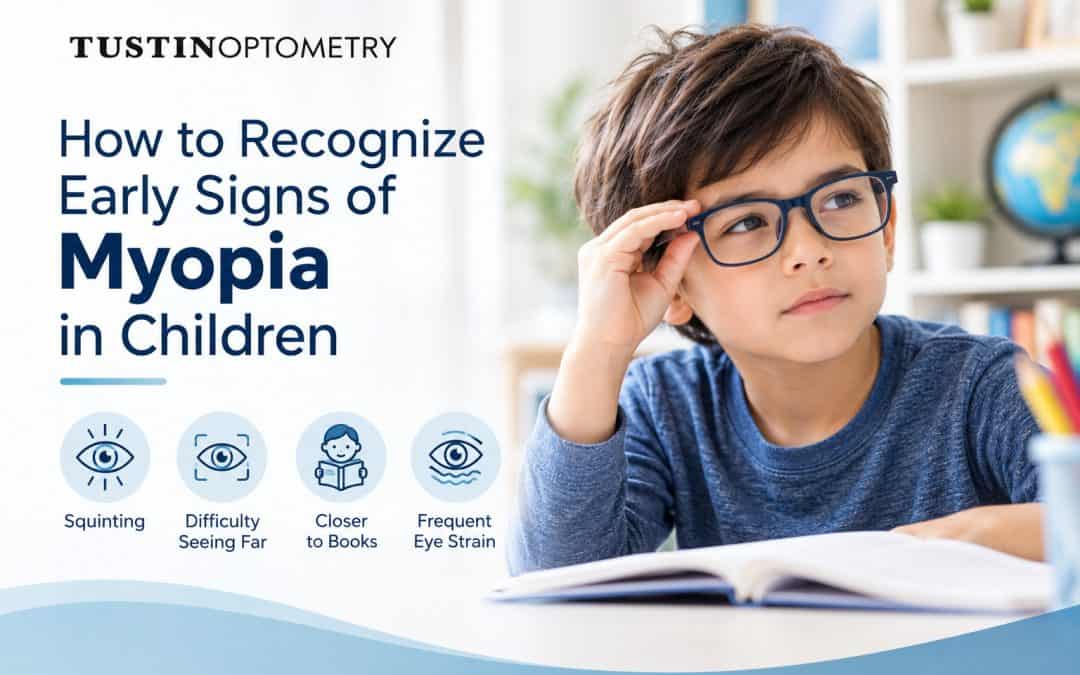
Quick Overview: Myopia can develop quietly in children, and many kids may not realize their distance vision is blurry. This guide explains common signs parents can watch for, such as squinting, sitting close to screens, and trouble seeing the board. It also explains why regular eye exams matter and how early care can help monitor changes in your child’s vision.
Your child may see the book in their hands clearly but struggle to read the board at school. That small change may be an early sign of myopia. Knowing what to watch for can help parents act before blurry distance vision starts affecting daily life.
For families in Tustin and nearby Orange County communities, regular eye exams for children can help identify vision problems that may not be obvious at home. A professional eye test for kids can check how clearly your child sees and assess overall eye health.
What Is Myopia in Children?
Myopia happens when the eye focuses light in front of the retina instead of directly on it. The retina is the light-sensitive layer at the back of the eye.
A child with myopia may see a book or tablet clearly but have trouble reading a classroom board, spotting a street sign, or seeing faces from across a room.
Myopia often starts during childhood. It may become stronger as the eyes grow, especially during the school-age years. Children with a family history of myopia have a higher risk.
6 Early Signs Parents Should Watch For
Children do not always know that their vision is blurry. They may think everyone sees the same way. That is why behavior can offer useful clues.
1. Your Child Squints Often
Squinting can temporarily make distant objects look clearer. If your child squints at the television, classroom board, signs, or other far-away objects, mention it during an eye visit.
2. They Sit Very Close to Screens
Does your child move closer to the TV or hold a tablet unusually close? This does not always mean myopia. Still, frequent close viewing is worth noting, especially if it happens with other signs.
3. They Struggle to See the Board
A child may start copying notes incorrectly or ask to sit closer to the front of the classroom. They may also complain that the writing on the board looks blurry. These changes can be easy to miss during a busy school year.
4. They Have Trouble Recognizing Things Far Away
Watch how your child responds to things across a room. Do they have trouble recognizing people from a distance? Do they miss signs or objects that you can see easily? These may be clues that distance vision needs checking.
5. They Cover One Eye
Some children cover or close one eye when watching television, reading, or looking at distant objects. This can be a sign of a vision problem and should be discussed with an eye care professional.
6. Schoolwork Suddenly Becomes Harder
Vision problems can affect reading, classroom work, and concentration. A child may not say, “I cannot see clearly.” Instead, you may notice more mistakes, frustration, or difficulty staying focused.
This does not mean myopia is always the cause. But a vision check can help rule it out.
Can Children Have Myopia Without Complaining?
Yes. Some children do not report blurry vision because they think their sight is normal. Others may rely on one eye more than the other.
This is one reason regular vision checks matter. Tustin Optometry provides pediatric eye care that looks at vision development, eye alignment, focusing ability, and overall eye health.
What Happens During a Child’s Eye Exam?
An eye test for kids is more than asking a child to read letters from a chart.
Depending on the child’s age, an eye care professional may check visual acuity, eye alignment, focusing ability, eye movement, and overall eye health. Eye drops may also be used during a complete exam to relax the focusing muscles and help measure the child’s prescription more accurately.
A vision screening and a full eye exam are not the same. A screening can flag a possible vision problem, while a complete eye exam provides a closer look at the child’s vision and eye health. Children who do not pass a screening may need further evaluation.
Can Myopia in Children Be Slowed?
In many children, myopia becomes stronger as they grow. There are treatment options that may help slow its progression. These can include certain specialty glasses, contact lenses, or low-dose atropine in selected cases.
The right approach depends on the child’s age, prescription, eye health, and other factors. Your eye care provider can explain which options may be appropriate.
Daily habits may also help. Encourage your child to spend time outdoors and take regular breaks during close-up work. AAPOS suggests the 20-20-20 rule: every 20 minutes, look about 20 feet away for 20 seconds.
When Should You Schedule an Eye Check?
Do not wait for your child to complain about blurry vision. If you notice squinting, trouble seeing the board, frequent eye covering, or other changes, schedule an eye evaluation.
For families in Tustin and nearby Orange County communities, Tustin Optometry offers child-friendly eye care from infancy through adolescence. Early testing can help identify vision problems and support healthy visual development.
Clear Vision Starts With Early Attention
Myopia can be easy to miss because children often adapt to blurry distance vision. A few simple changes in behavior may be the first clue.
If your child is squinting, sitting close to screens, or struggling to see things across the room, do not ignore the signs. A timely eye check can help identify myopia and guide the next step. For parents in Tustin and nearby areas, regular pediatric eye care can help keep your child’s vision on track.
Schedule an eye exam for your child with Tustin Optometry today and give their growing eyes the care they need.
FAQs
1. What are the early signs of myopia in children?
Common signs include squinting, sitting close to screens, holding books close, trouble seeing the board, and difficulty recognizing people or objects far away.
2. At what age can children develop myopia?
Myopia can develop during childhood and often becomes noticeable during the school years. Regular eye checks can help spot changes early.
3. Can a child have myopia without knowing it?
Yes. Children may think blurry distance vision is normal. They may not complain, so routine eye checks are important for finding unnoticed vision problems.
4. How can parents tell if their child needs an eye test for kids?
Watch for squinting, frequent eye rubbing, sitting close to screens, headaches, poor distance vision, or trouble seeing classroom boards.
5. How often should children have eye exams?
The timing depends on age, risk factors, and eye health. Your eye care provider can recommend an exam schedule suited to your child.
Recent Comments